See the chemistry in real life
Ideas are connected to where chemistry is actually used, from medicines to the human body, so they make sense and stay in your memory.
GCSE Chemistry
Mr M Khan is a qualified Chemistry teacher working in a school ranked in the world’s top 100, and an examiner who knows exactly how marks are awarded. He has worked as a pharmacist, and studied Pharmacology and Cancer Biology. Your school teaches the content; he gives you the exam practice the school year runs out of time for.
 Taught by Mr M KhanFormer pharmacist · Former Principal · Examiner
Chemistry Lead
Mr M Khan came to Chemistry through medicine. A former pharmacist with degrees in Pharmacology and Cancer Biology, he has taught for 11 years across five schools, serving as an Assistant Headteacher and then a Principal. He brings examiner experience and real clarity to every GCSE lesson.
I am looking for students who want Chemistry to open a door: medicine, pharmacy, dentistry or a science degree. You may already know the content. I am here for the marks that decide the grade.
Thirty-five marks. That is all a grade 9 in Pearson Edexcel GCSE Chemistry left room to drop this summer, out of 200 across both Higher papers. Most marks are won or lost in one place: exam practice. And exam practice is the one thing the school year never has enough time for.
I know this because I still teach in a school, one ranked among the top 100 in the world. The Chemistry specification is enormous, and your teacher has to get through all of it: bonding, quantitative chemistry, rates, organic chemistry, core practicals. By the time the content is finished, there are often only a few weeks left to practise answering the questions themselves. That is not your teacher’s fault. It is simply how the school calendar works, whether you are in Year 10 or Year 11.
My programme gives you that time back. We meet for two live lessons a week, following the Pearson Edexcel GCSE specification, alongside your school lessons rather than instead of them. We cover the full specification, but every topic ends the same way: on real exam questions, marked against the mark scheme, so you can see exactly which words earn marks and which ones lose them. Every lesson is recorded, so the night before a test you can watch the explanation again.
It works. In 2024–25, two thirds of my A-Level Chemistry class achieved an A* or A, more than double the national rate of 32.6%, and a third achieved an A*, against 9.5% nationally.
I also bring something most Chemistry teachers can’t. My background is in the chemistry of medicine: I have worked as a pharmacist, and I hold a degree in Pharmacology and a Masters in Cancer Biology. If you are heading towards medicine, pharmacy or dentistry, I can show you where the Chemistry you are learning actually turns up in the real world. Having led schools as an Assistant Headteacher and a Principal, and now running my own tuition centre in Dubai, I also know which habits separate a grade 7 from a grade 9, and how to build them.
Keep learning from your teacher at school, and come and practise with me. If you are aiming for a grade 9, and Chemistry is part of where you want to go next, I would love to help you get there.
Mr M Khan
Pearson Edexcel GCSE Chemistry (1CH0) Higher tier grade boundaries, June 2026: grade 9 at 165/200.
Ideas are connected to where chemistry is actually used, from medicines to the human body, so they make sense and stay in your memory.
Every topic is taken onto real exam questions, so you see exactly which detail earns each mark and which answers fall just short.
If you understand it in class but lose marks in the exam, we find where the marks are slipping and fix the method behind them.
GCSE Chemistry: Tuesdays and Thursdays, 16:00–16:30 UK time. Thirty-minute lessons.
Lessons run from 17 October.Lessons began on 17 October and run until 30 June 2027.
UK time is shown by default. Switch to UAE time above to see the equivalent local lesson times.
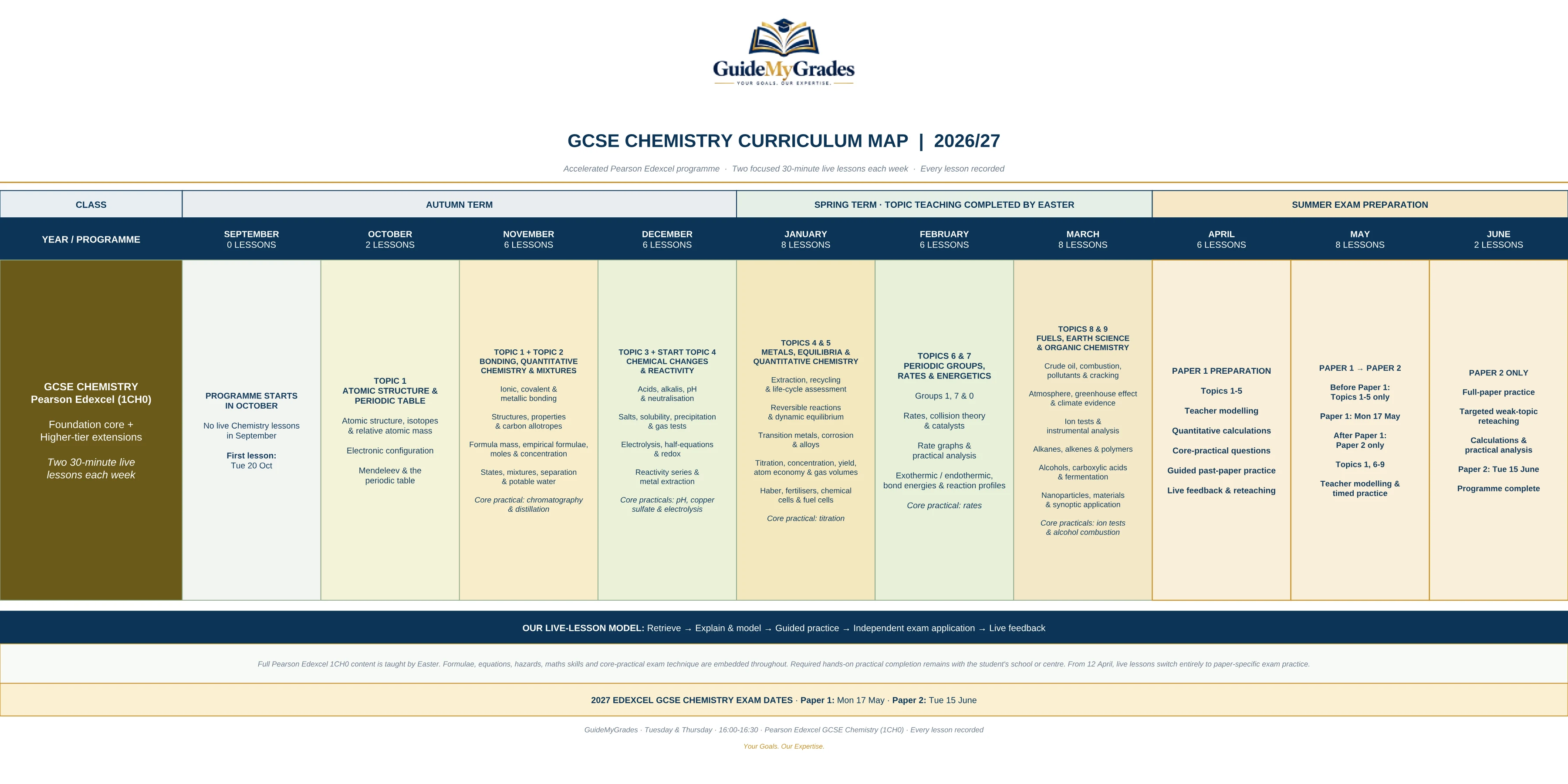
Topic 1, atomic structure and the periodic table. Topic 2, bonding, structure, quantitative chemistry and separating mixtures. Topic 3 and the start of Topic 4: acids, salts, electrolysis and reactivity. Core practicals: chromatography, distillation, pH, copper sulfate and electrolysis.
Topics 4 to 9: metals and equilibria, groups 1, 7 and 0, rates of reaction, energy changes, fuels and earth science, and organic chemistry, with calculations throughout. Core practicals: titration, rates, ion tests and alcohol combustion. Every topic is taught by Easter.
Exam preparation with timed past-paper practice, calculations and core-practical questions: Paper 1 (Topics 1 to 5) on Monday 17 May, then Paper 2 (Topics 1 and 6 to 9) on Tuesday 15 June 2027.
Every booklet is real Pearson Edexcel exam questions on a single topic, with the mark scheme built straight into the page.
Live teaching follows Pearson Edexcel GCSE Chemistry (1CH0), Foundation and Higher tier. The free booklets also cover IGCSE and A-Level.
Open the Chemistry bookletsGCSE Chemistry (1CH0) or Combined Science, at Foundation or Higher. Pick the booklets that match your exam.
Answer a full booklet on a single topic, then mark it. Patterns in what you miss show up fast.
Places are open now. Choose GCSE Chemistry, book online, and tell Mr M Khan the topics that still do not make sense.
Tell us your year group, exam board and the Chemistry topic giving you the most trouble. We will match you to the right programme.
Ask a question ↗ See pricing