One clear step at a time
Every method is broken into clear steps and explained, so you understand why it works as well as how to do it.
GCSE Maths
Mr M Adan is a qualified teacher who has taught Maths in the classroom for five years, and still teaches GCSE in school every week. He trained as an engineer first, so he teaches why each method works, not just what to write. He finds the step that’s been holding you back and turns it into marks.
 Taught by Mr M AdanQualified teacher · 5 years teaching Maths
Maths Lead
Mr M Adan is a qualified teacher who has taught Maths in the classroom for five years. Before teaching, he trained as an engineer, so he learned maths by using it. Now he helps GCSE students turn shaky foundations into a method they can trust.
I am looking for students who have decided they are ‘not a maths person’. Nine times out of ten, one step got missed and everything after it stopped making sense. Find that step, and Maths starts working again.
“I’m just not a maths person.”
I hear that a lot, and nine times out of ten it isn’t true. Usually one step got missed years ago, such as fractions, negative numbers or rearranging an equation, and in a busy classroom there’s rarely time to go back and find it.
I’m a classroom teacher too, so I understand why. Your teacher has a full GCSE course to finish and a full class to teach. When most of the room is ready to move on, the lesson has to move on. Going back to fill a gap, or sitting down to practise a whole paper together, is usually the first thing to get squeezed out.
That practice matters more than most students realise. This summer, a grade 9 on the Pearson Edexcel Higher tier needed 208 marks out of 240, leaving room to drop just 32 marks across all three papers. Whether you’re aiming for a 4 or a 9, your grade comes down to careful method on real exam questions, and that takes practice time.
That’s what my GCSE Maths programme is for. We meet for two live lessons a week in a small group, working alongside your school lessons. We cover the full course, find any missing steps and rebuild them calmly, then practise on real Pearson Edexcel GCSE questions every time. I trained as an engineer, so I’ll show you why each method works, not just what to write. I’ll also show you how to set out your working so you collect every method mark available. Every lesson is recorded, so nothing is ever lost if you miss something.
Your teacher at school builds the foundations, and I’ll help you turn them into marks. You’ll never be made to feel silly for asking a question. Bring me the topic you dread most. By the summer, I want you to trust your own method.
Mr M Adan
Pearson Edexcel GCSE Mathematics (1MA1) Higher tier grade boundaries, June 2026: grade 9 at 208/240.
Every method is broken into clear steps and explained, so you understand why it works as well as how to do it.
When a topic stops making sense, we go back to the step that was missed, then rebuild everything that comes after it.
You learn to lay out every answer so the method marks are there to be given, whether you are aiming for a grade 4 or a grade 9.
GCSE Maths: Mondays and Wednesdays, 16:00–16:30 UK time. Thirty-minute lessons.
Lessons run from 17 October.Lessons began on 17 October and run until 30 June 2027.
UK time is shown by default. Switch to UAE time above to see the equivalent local lesson times.
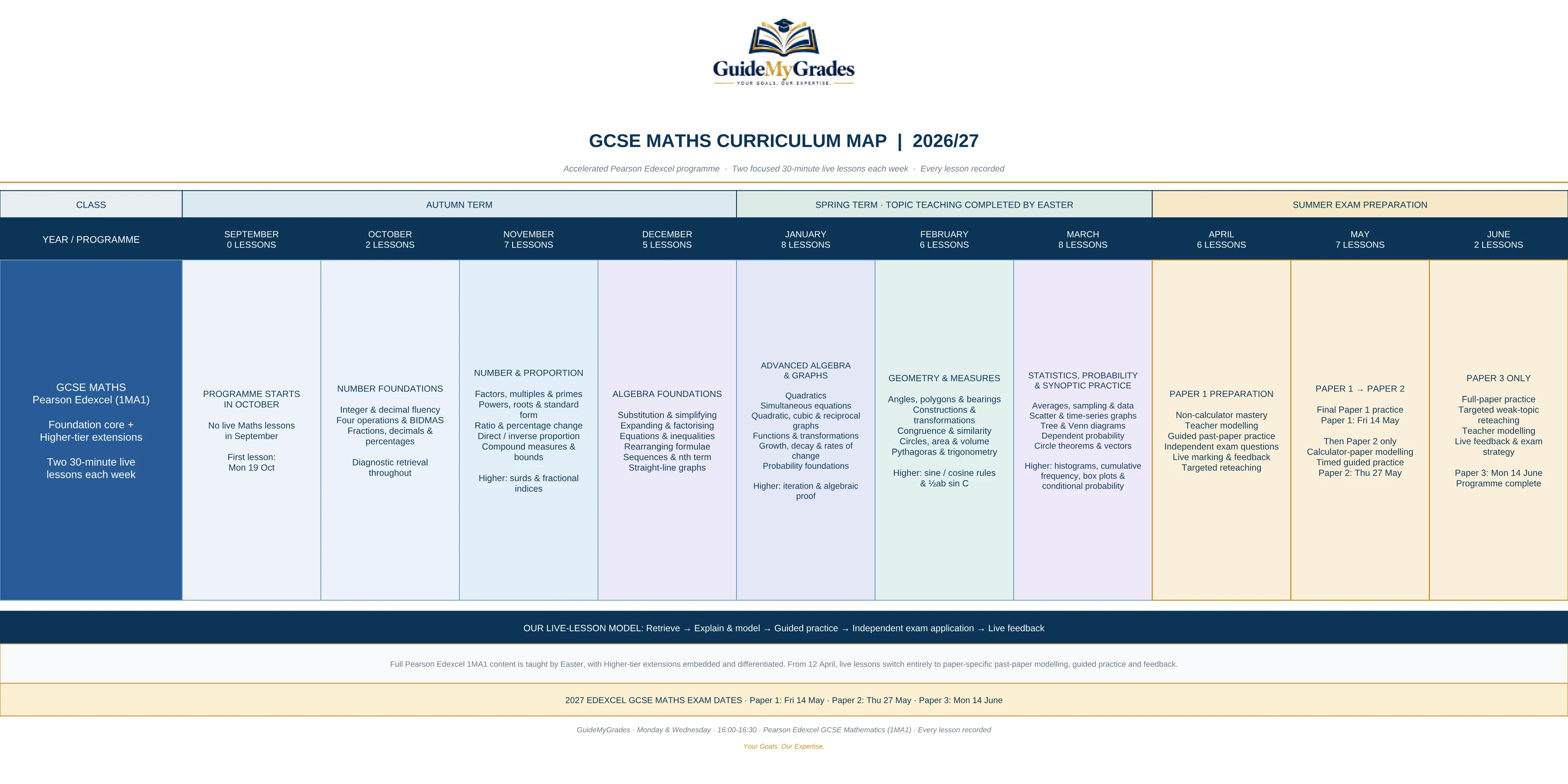
Number foundations, then number and proportion: fractions, decimals and percentages, powers and standard form, ratio, direct and inverse proportion, compound measures and bounds. Then algebra foundations: expanding, factorising, equations, inequalities, formulae, sequences and straight-line graphs.
Advanced algebra and graphs: quadratics, simultaneous equations, functions, transformations and growth and decay. Geometry and measures: angles, bearings, congruence and similarity, circles, area and volume, Pythagoras and trigonometry. Then statistics and probability. Every topic is taught by Easter, with Higher-tier extensions throughout.
Paper-by-paper exam preparation with timed past-paper practice and live feedback: Paper 1 (non-calculator) on Friday 14 May, Paper 2 on Thursday 27 May and Paper 3 on Monday 14 June 2027.
Each one collects real past-paper questions on a single topic, with the mark scheme built straight into the page. GCSE and International GCSE booklets come in Foundation and Higher tier, so you practise the exact papers you will sit.
Taking Further Maths, IGCSE Further Pure Maths or the International A-Level Further Pure units? They have their own free booklets. Live teaching follows Pearson Edexcel GCSE Mathematics (1MA1), Foundation and Higher tier.
Open the Maths bookletsFractions, algebra, ratio, circle theorems, probability: name the GCSE topic where your marks slip, so we start exactly there.
Work the question first. Then check which step earns each method mark, not just the final answer.
Places are open now. Choose GCSE Maths, book online, and your child joins live lessons from 17 Octoberthe next live lesson.
Tell us your year group, exam board and the Maths topic giving you the most trouble. We will match you to the right programme.
Ask a question ↗ See pricing