Decode the question
We pull apart the task, the extract and the assessment focus first. You learn what this question rewards before a word is written.
GCSE & A-Level English
Most answers lose marks by explaining what happens instead of how the writer makes it happen. An AQA examiner shows you the difference, then helps you write it.
 Taught by Ms N YasminAQA examiner · 12+ years tutoring
 Watch Ms N Yasmin teachA real sample lesson
English Lead
More than twelve years of tutoring English, five years teaching in a London school, AQA examiner, and has managed a tuition centre.
I am looking for students who know the text well but keep hearing the same comment: “You’re just retelling the story.” You read it, you understand it, and your mark still doesn’t move. If that sounds like you, you are exactly who I want in my class.
I have spent more than twelve years tutoring English, managing a tuition centre and teaching in a London school, and I have taught many students exactly like this. I have also watched them change. Year after year, my GCSE English classes beat the national figures at every grade boundary. In 2024, 42% of my GCSE English Literature students achieved grades 9 to 7, more than double the national rate. In 2025, half of my A-Level English Literature class achieved A* or A, against a quarter nationally, and every one of them passed.
Marking papers as an examiner showed me the difference is rarely knowledge. It is how you write about what you know. So we stop retelling and start explaining how the writer makes it work: one short extract, why this word, why here, then a paragraph built together sentence by sentence before you write your own.
Bring me the essay that came back with a disappointing mark. We will find out exactly where the marks went, and we will win them back together.
Ms N Yasmin
We pull apart the task, the extract and the assessment focus first. You learn what this question rewards before a word is written.
Ms N Yasmin models how to pick evidence and develop an interpretation live. Then you write your own and get specific feedback on it.
Language analysis, comparison or writing for an audience: we practise until each sentence earns its place in the mark scheme.
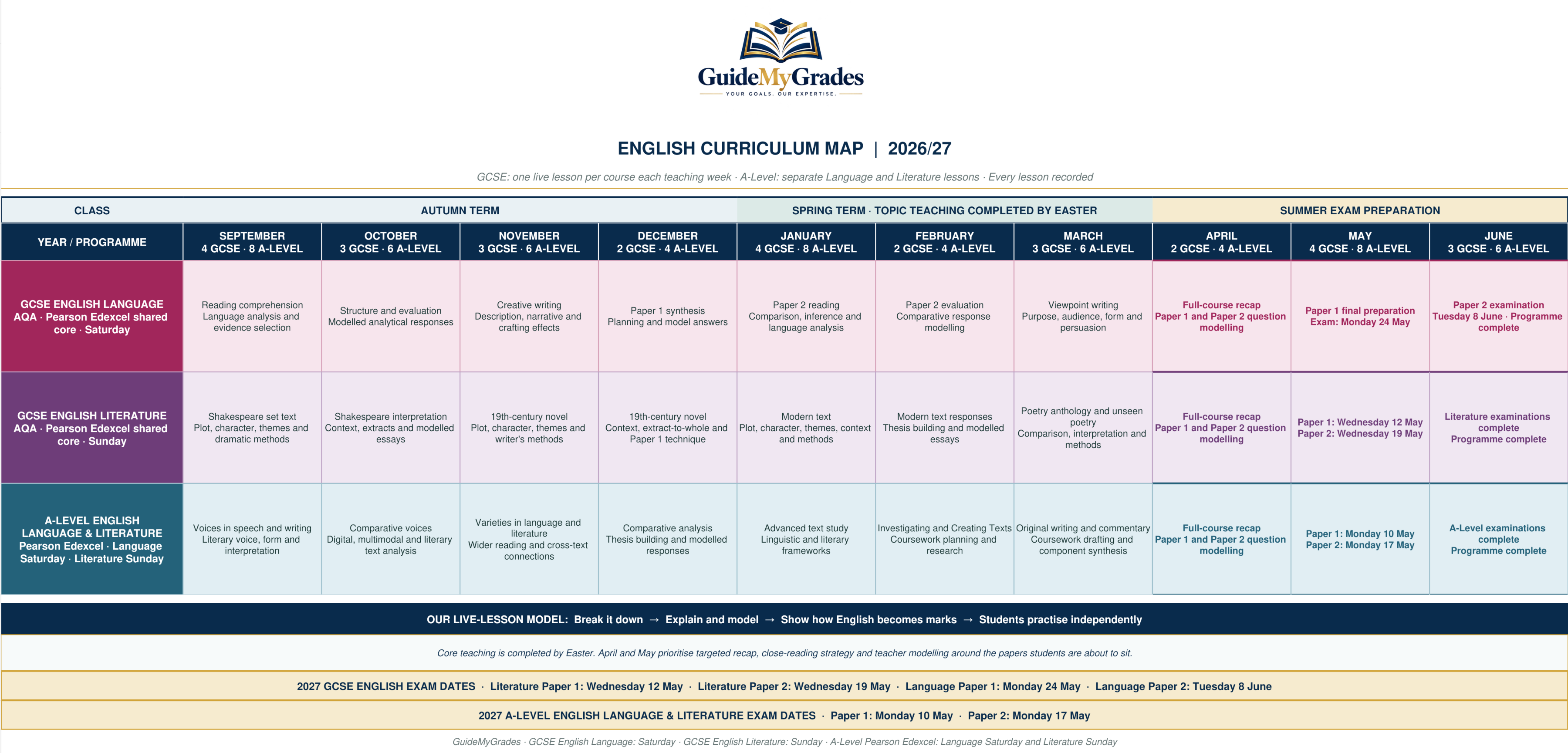
GCSE English: Saturdays (Language), 09:30–10:00 UK time; Sundays (Literature), 09:30–10:00 UK time. Thirty-minute lessons.
A-Level English Language and Literature: Saturdays (Language), 12:00–12:40 UK time; Sundays (Literature), 10:20–11:00 UK time. Forty-minute lessons.
Lessons run from 17 October.Lessons began on 17 October and run until 30 June 2027.
UK time is shown by default. Switch to UAE time above to see the equivalent local lesson times.
Grouped by question number, so every Question 1 sits together, then every Question 2, and so on. The mark scheme is built straight into the page.
Live teaching also covers GCSE English Literature and A-Level English Language and Literature (Pearson Edexcel).
Open the English bookletsTell us your year group, exam board and the English topic giving you the most trouble. We will match you to the right programme.
Ask a question ↗ See pricing